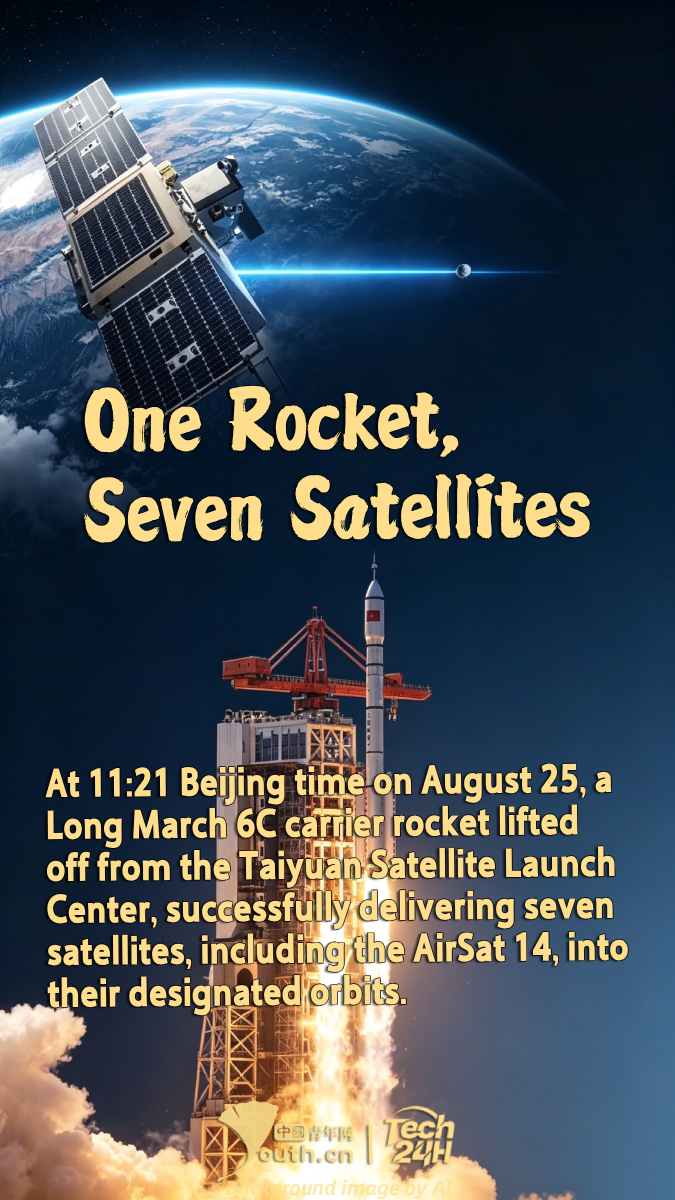
【#Tech24H】At 11:21 Beijing time on August 25, a Long March 6C carrier rocket lifted off from the Taiyuan Satellite Launch Center, successfully delivering seven satellites, including the AirSat 14, into their designated orbits. The flight test mission was a complete success. Among the seven satellites launched, the GISTDA Cube Sat 1, AirSat 14, and AirSat 15 were developed by GALAXYSPACE. The GISTDA Cube Sat 1, whose user is the Geo-Informatics and Space Technology Development Agency (GISTDA) of Thailand, is primarily used to provide remote sensing data collection services for terrestrial, agricultural, and ecological surface monitoring for the Thai side, and at the educational level, it supports Thai universities in practical teaching in satellite design and development, aerospace tracking and control, and remote sensing applications. Also launched were the Muduo 1A satellite, Muduo 1B satellite, Jing’an Dream Star, and Bayi 04 satellite. Another satellite, “Muduo 1”, is part of a constellation developed by Beijing Normal University, featuring space computing and space interconnect capabilities. The algorithms and AI large models onboard can identify, diagnose, and provide early warnings for over ten types of surface anomalies such as wildfires and landslides, and in the future, they are expected to significantly shorten the warning time for such events.[ By Zhang Liyan | Tang Ruohan ]