
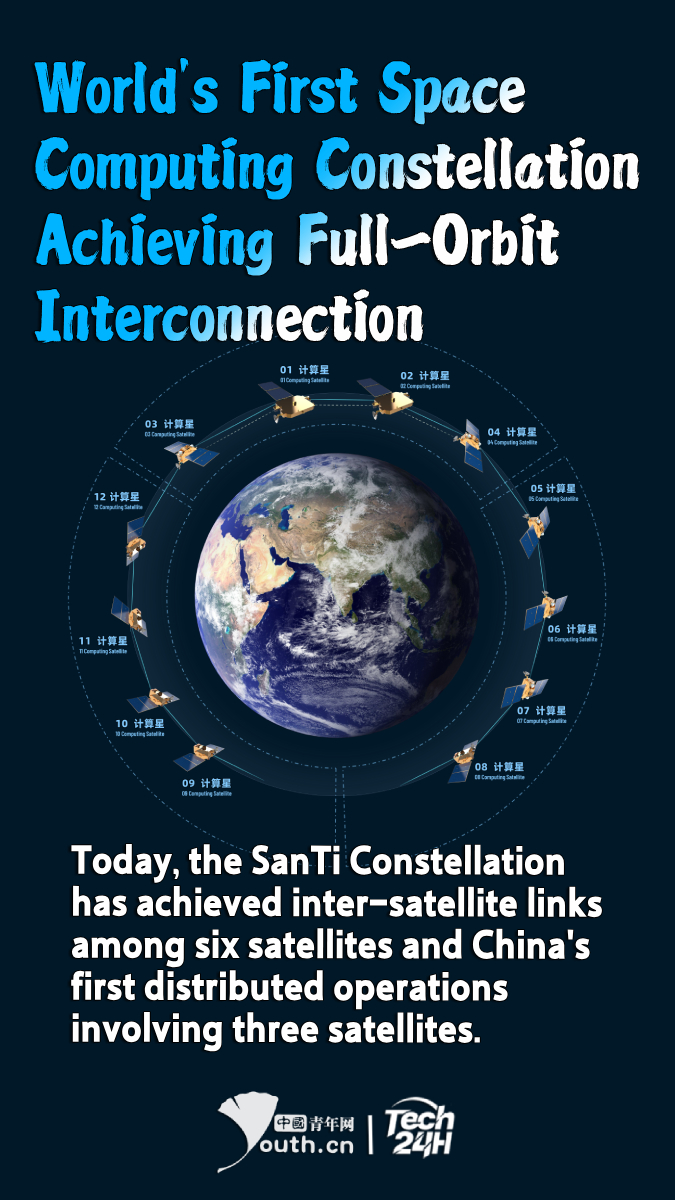
【#Tech24H】Led by Zhijiang Lab, the SanTi Computing Constellation is the world’s first space computing constellation to achieve full-orbit interconnection. Its first 12 computing satellites were successfully launched into orbit on May 14, 2025. Why build a space computing constellation? Although there are many satellites in orbit, few are effectively utilized, mainly due to three reasons: limited by satellite-ground transmission bandwidth and the number and distribution of ground stations, 90% of data never reaches the ground and is wasted in space; data transmission is slow, with remote sensing data taking over an hour on average to be sent back; and satellites are not “smart” enough, traditional satellites operate in a “kite-flying” single-link mode, controlled remotely by ground stations one by one, lacking autonomous capabilities. Today, the SanTi Constellation has achieved inter-satellite links among six satellites and China’s first distributed operations involving three satellites. Its in-orbit computing power has reached 5 POPS (5,000 trillion floating-point operations per second), the largest in the world. A single satellite can deliver up to 744 TOPS (744 trillion operations per second) and support the in-orbit operation of models with up to 140 billion parameters. Eleven AI models have been successfully deployed, including a space-based remote sensing model with 8 billion parameters, the largest of its kind in orbit, and an 8billionparameter space-based astronomical time-domain model, with model deployment and in-orbit updates completed within two days. [ By Zhang Liyan | Tang Ruohan ]