
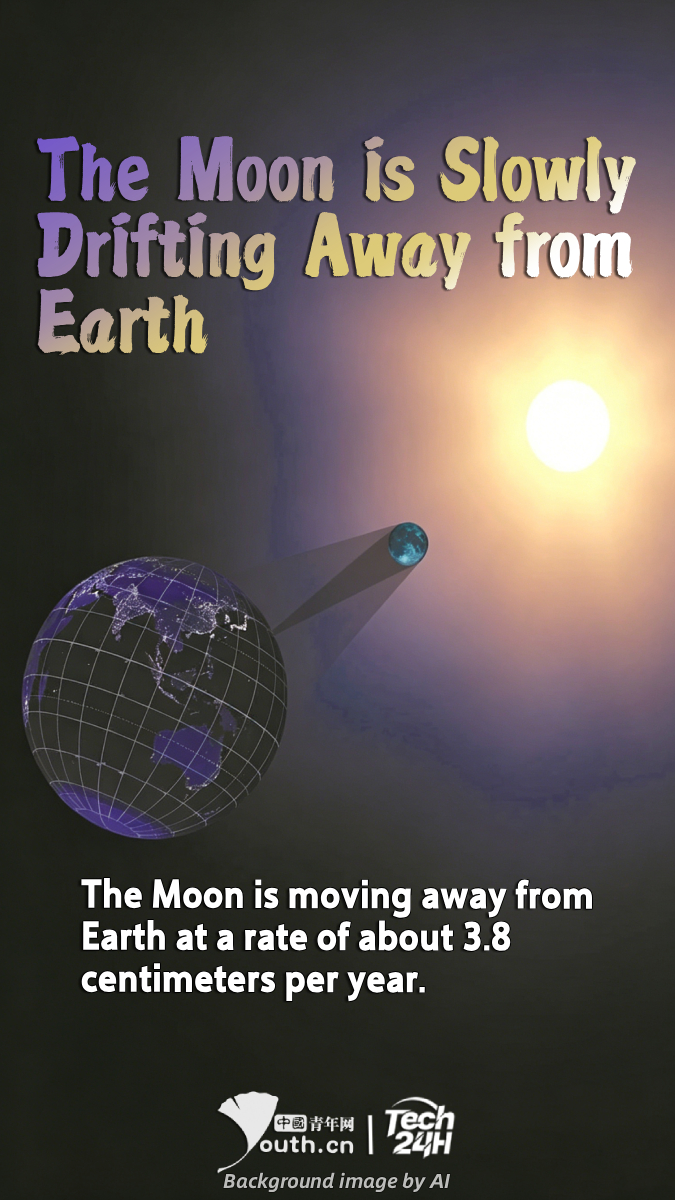
【#Tech24H】The total solar eclipses that humans can witness today may become a “limited edition” phenomenon in the future. In the distant future, humanity may completely lose the opportunity to observe this spectacular celestial event. The answer lies in a nearly imperceptible change: the Moon is moving away from Earth at a rate of about 3.8 centimeters per year. A total solar eclipse occurs because the Sun’s diameter is roughly 400 times that of the Moon, while the Sun’s distance from Earth is also about 400 times the Moon’s distance from Earth. These two “400x” factors nearly cancel each other out in terms of angular size, making the Sun and Moon appear almost the same size when viewed from Earth. Only when the Moon moves into a specific position can it completely block the Sun’s photosphere, creating the brief darkening of daylight and the appearance of the solar corona that characterize a total eclipse. A rate of 3.8 cm per year seems tiny, but over astronomical timescales it is changing the geometry of the EarthMoon system. According to current calculations, in about 600 million years, the Moon’s angular diameter will become smaller than the Sun’s. Even at perigee, the Moon will no longer be able to fully cover the solar disk. Total solar eclipses will vanish, replaced by annular and partial eclipses. Ultimately, the total solar eclipse will exist only in the recorded history of human observation. [ By Zhang Liyan | Tang Ruohan ]