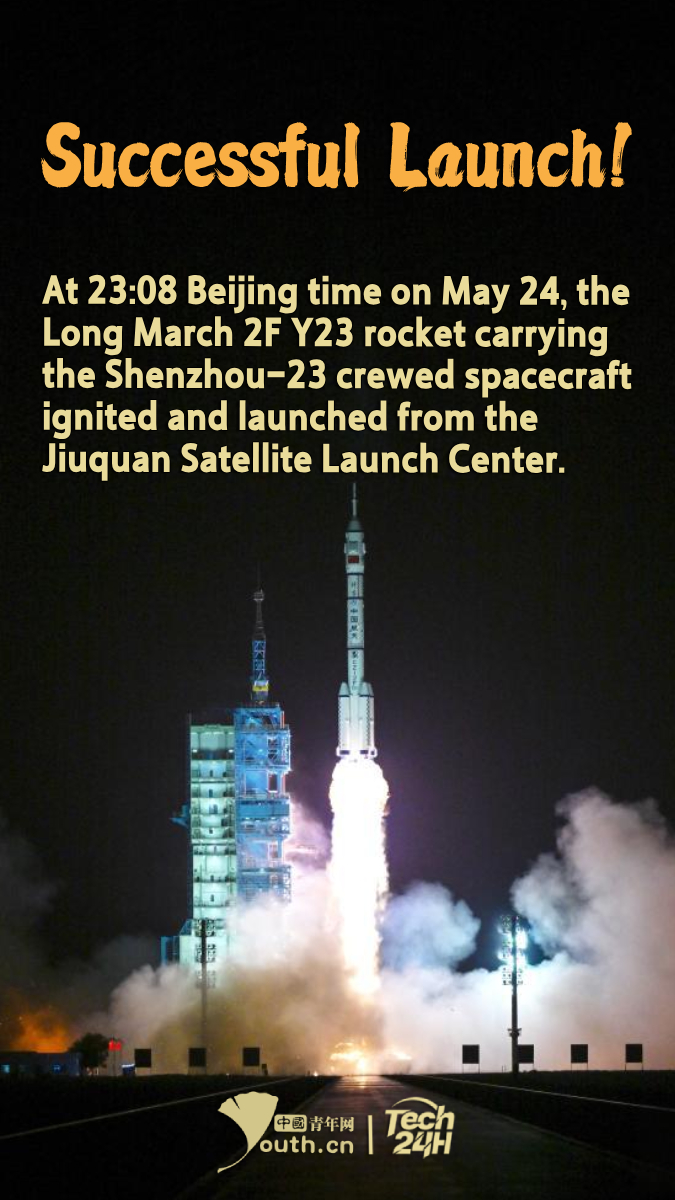
【#Tech24H】At 23:08 Beijing time on May 24, the Long March 2F Y23 rocket carrying the Shenzhou-23 crewed spacecraft ignited and launched from the Jiuquan Satellite Launch Center. About ten minutes later, the spacecraft successfully separated from the rocket and entered its planned orbit. The astronaut crew is in good condition, and the launch was a complete success. The spacecraft will perform an autonomous fast rendezvous and docking with the space station complex according to the scheduled procedure. The Shenzhou-23 crew will conduct an inorbit handover with the Shenzhou-21 crew. During their stay aboard the space station, the Shenzhou23 crew will carry out multiple experiments and applications in areas such as space life and human research, microgravity physical sciences, and new space technologies. They will conduct several extravehicular activities (EVAs) and complete tasks including installation, debugging, maintenance, and repair of equipment inside and outside the module. Notably, experimental materials such as rice seeds have been sent to the China Space Station aboard the spacecraft. This experiment will, for the first time, achieve two generations of rice cultivation in orbit, potentially completing a full growth cycle from seed to seed and then to a new generation of seeds in space, and will analyze the effects of longterm microgravity on the genetic stability of rice. [ By Zhang Liyan | Tang Ruohan ]