
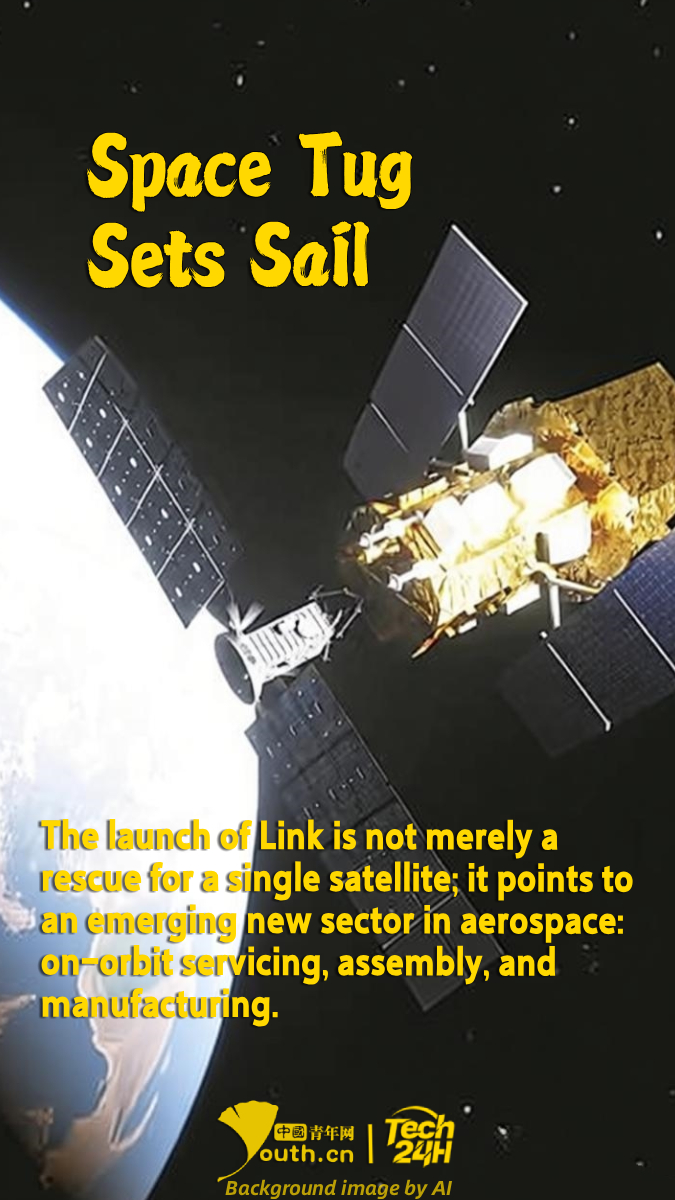
【#Tech24H】High above the Kwajalein Atoll in the Marshall Islands, a modified L1011 aircraft recently released a Pegasus XL rocket, which placed a spacecraft codenamed “Lianjie” into its intended orbit. Shortly after, Link successfully established communication with Earth. Over the coming weeks, it will undergo a comprehensive checkout of its propulsion, sensing, and navigation systems, before heading off on a space rescue mission: the Swift astronomical satellite, which has been in service for more than two decades beyond its design life and is slowly falling toward Earth. “Lianjie” is compact, weighing about 400 kilograms and standing about 1.5 meters tall, only onethird the size of Swift, with solar panels spanning about 6 meters when deployed. It integrates three ion thrusters and three robotic arms, and over the next few months it will gradually approach Swift, then perform a docking maneuver described as “a dance on the tip of a needle”. The launch of Link is not merely a rescue for a single satellite; it points to an emerging new sector in aerospace: onorbit servicing, assembly, and manufacturing. In the past, once a satellite reached orbit, its fate was sealed; depletion of fuel or orbital decay meant the end. Northrop Grumman’s Mission Extension Vehicles have already provided stationkeeping services for commercial communications satellites, proving the commercial viability of inorbit life extension. Technologies that enable onorbit repair, life extension, and even decommissioning of defunct satellites will become critical infrastructure for the sustainable use of space. For operators, lifeextension services cost far less than launching new satellites; for the scientific community, this means irreplaceable spacecraft like Swift and Hubble can enjoy extended operational lives.[ By Zhang Liyan | Tang Ruohan ]