
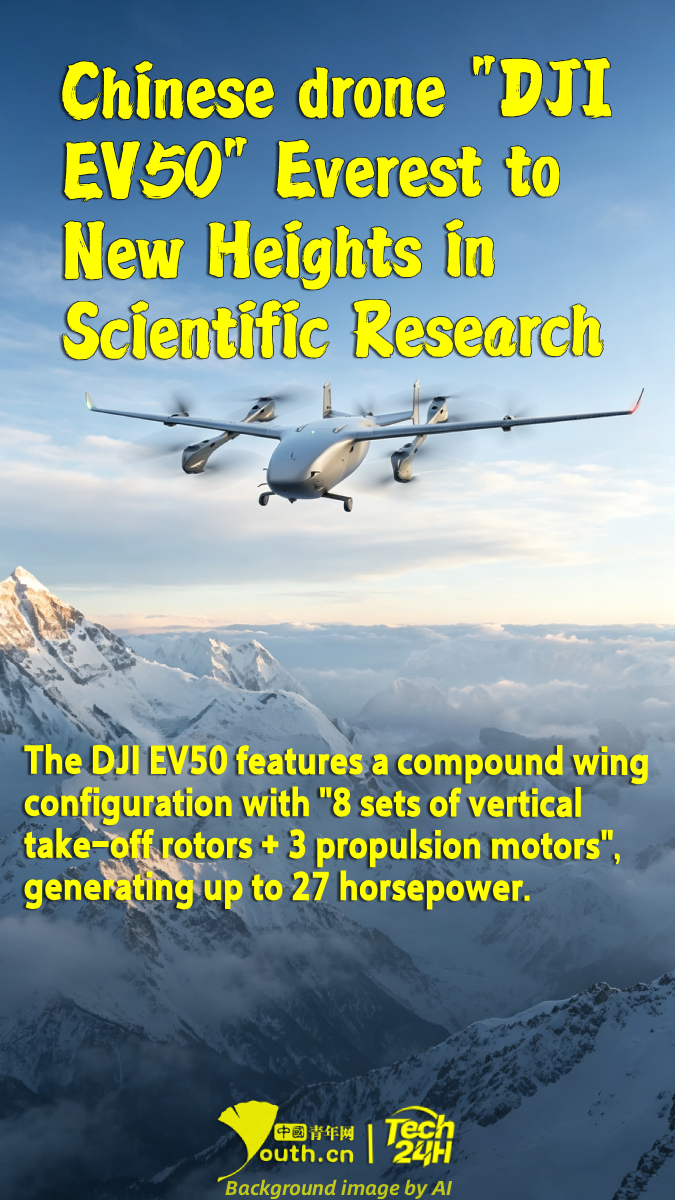
【#Tech24H】On July 9, DJI unveiled a new-concept drone, the DJI EV50. This VTOL (vertical take-off and landing) cargo drone, which combines the advantages of multi-rotor and fixed-wing designs, accompanied a Chinese scientific expedition team to the north slope of Everest this year. Taking off from the 5,200meter base camp, it flew over the 8,848meter summit and reached a maximum altitude of 8,861 meters, setting a new record for highaltitude scientific drone operations. The DJI EV50 features a compound wing configuration with “8 sets of vertical takeoff rotors + 3 propulsion motors”, generating up to 27 horsepower. It is the first to employ innerrotor motors, with dense heat dissipation and air intakes to cope with the thin atmosphere. In addition, the rapidly changing highaltitude winds over Everest expose the drone to sudden rises and drops in relative airspeed caused by wind shear, which can lead to stalls. When the flight control system detects a sudden airspeed drop, it automatically boosts thrust output within milliseconds to counteract the wind shear effect. Meanwhile, battery selfheating technology ensures stable power supply for flight, and pitot tube lowtemperature heating prevents ice blockage, ensuring that the airspeed sensing system remains accurate and reliable in snow and wind. The drone is also equipped with four elevators, four ailerons, and four batteries to enhance flight safety, with a wholeaircraft parachute as a final safety net.[ By Zhang Liyan | Tang Ruohan ]