
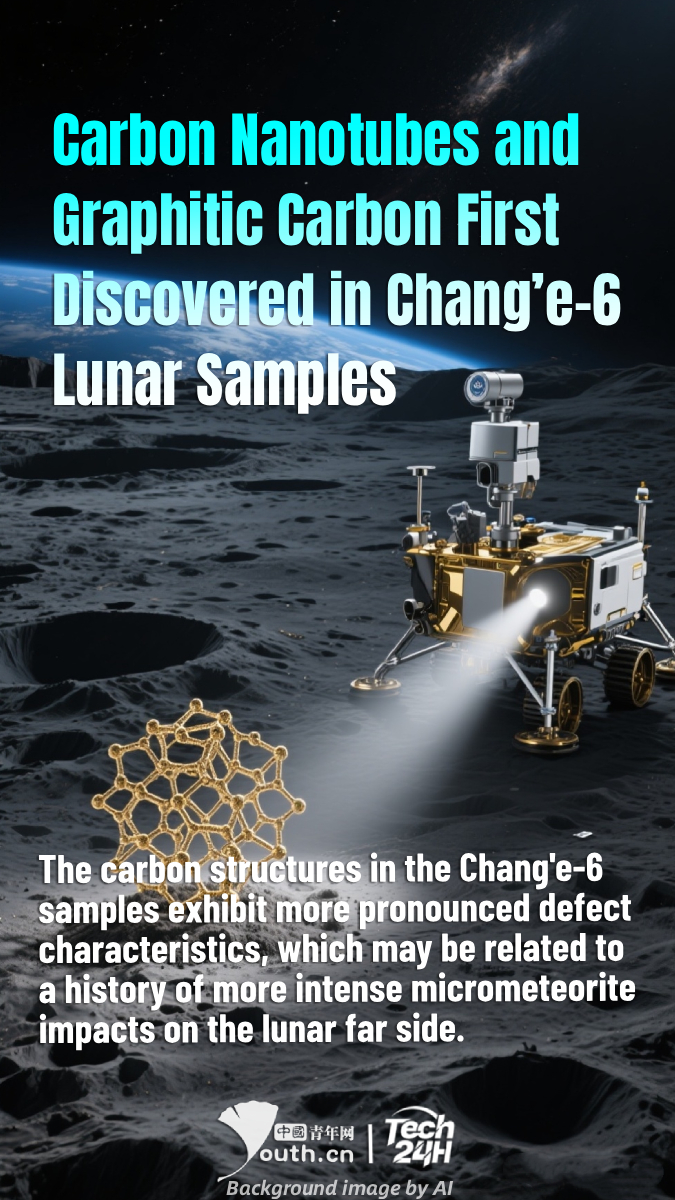
Through systematic analysis of lunar soil samples returned by the Chang’e-6 mission, China has, the first time in the world, discovered and confirmed naturally occurring single-walled carbon nanotubes and graphitic carbon. This finding reveals the intricacy of high-energy physical and chemical processes on the lunar surface, supports the hypothesis of more active geological activity on the far side of the Moon, and provides crucial data for studying the lunar evolution history. Most importantly, it represents the first international confirmation of the natural existence of single-walled carbon nanotubes without artificial intervention. By comparing the far-side samples from Chang’e-6 with the near-side samples from Chang’e-5, the research team also found that the carbon structures in the Chang'e-6 samples exhibit more pronounced defect characteristics, which may be related to a history of more intense micrometeorite impacts on the lunar far side. Additionally, this discovery unveils new asymmetries in material composition and evolutionary processes between the near side and far side of the Moon.