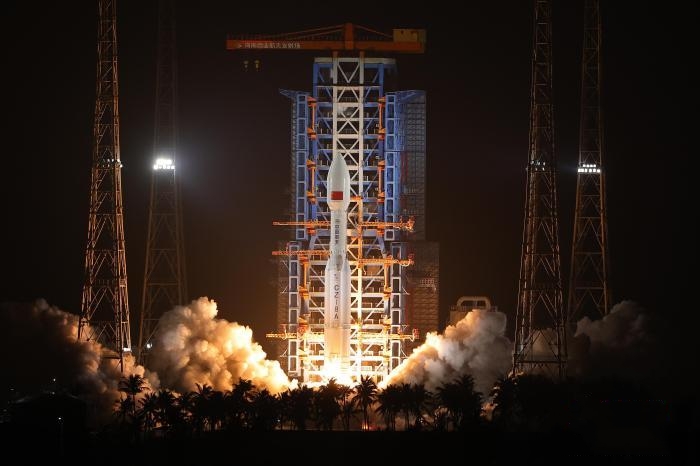
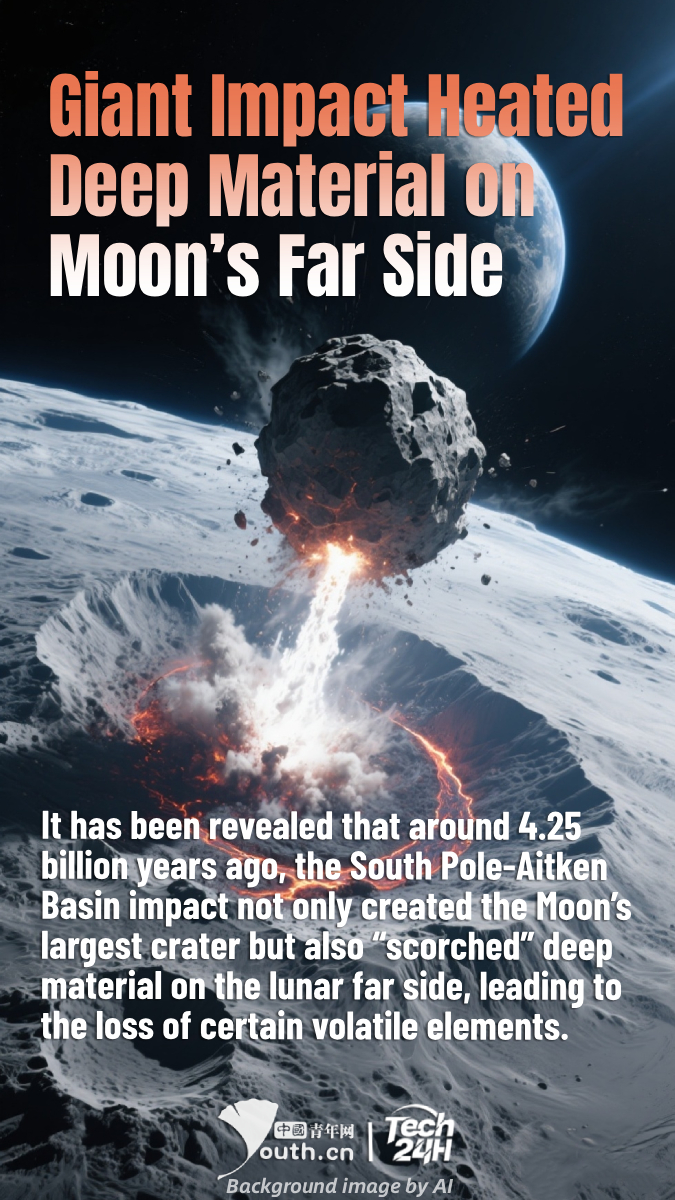
【#Tech24H】The Chang'e-6 mission successfully collected samples from the Moon’s largest impact basin, the South Pole-Aitken Basin, providing critical specimens for studying the massive South Pole-Aitken impact event and its effects. Researchers from the Institute of Geology and Geophysics of Chinese Academy of Sciences detected subtle variations in isotope ratios through high-precision isotopic analysis, precisely capturing traces left by the impact event. For the first time, it has been revealed that around 4.25 billion years ago, the South Pole-Aitken Basin impact not only created the Moon’s largest crater but also “scorched” deep material on the lunar far side, leading to the loss of certain volatile elements.