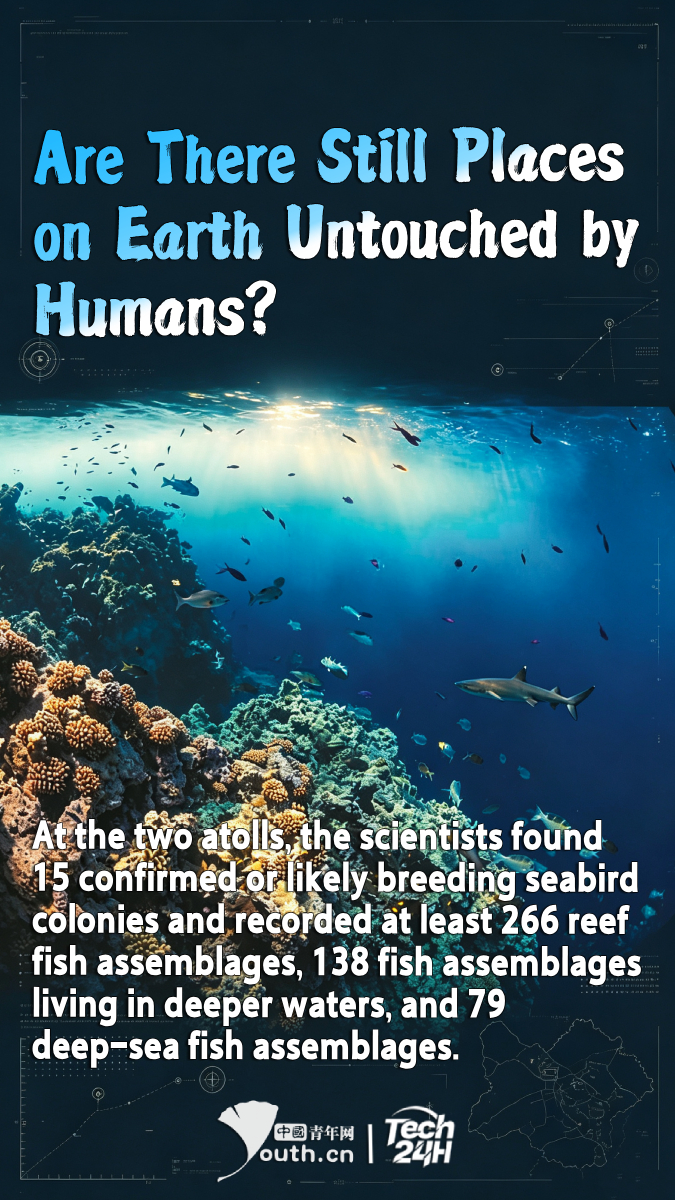
【#Tech24H】A group of scientists led by the University of Hawaii finally found Bikar Atoll and Bokak Atoll in the Marshall Islands deep in the Pacific. Located at the northernmost end of the Marshall Islands, the two atolls are about 116 km and 385 km from the nearest inhabited atolls, respectively. In November this year, the scientists confirmed that they may be among the best-preserved ecosystems in the region and even globally, and can be described as the Earth’s “last remaining wild and healthy marine ecosystems.” At the two atolls, the scientists found 15 confirmed or likely breeding seabird colonies and recorded at least 266 reef fish assemblages, 138 fish assemblages living in deeper waters, and 79 deep-sea fish assemblages. They also observed 15 open-water predator groups, including sharks, jacks, and wahoo. Fourteen of these groups had not previously been recorded in the Marshall Islands, and the other two may even be species new to science. The value of this treasure lies not only in its “high species count”, but also in showing what marine ecosystems can look like when intense human disturbance is kept at a distance. They serve as a benchmark that helps people understand what has been lost elsewhere and provides a reference for conservation and restoration.