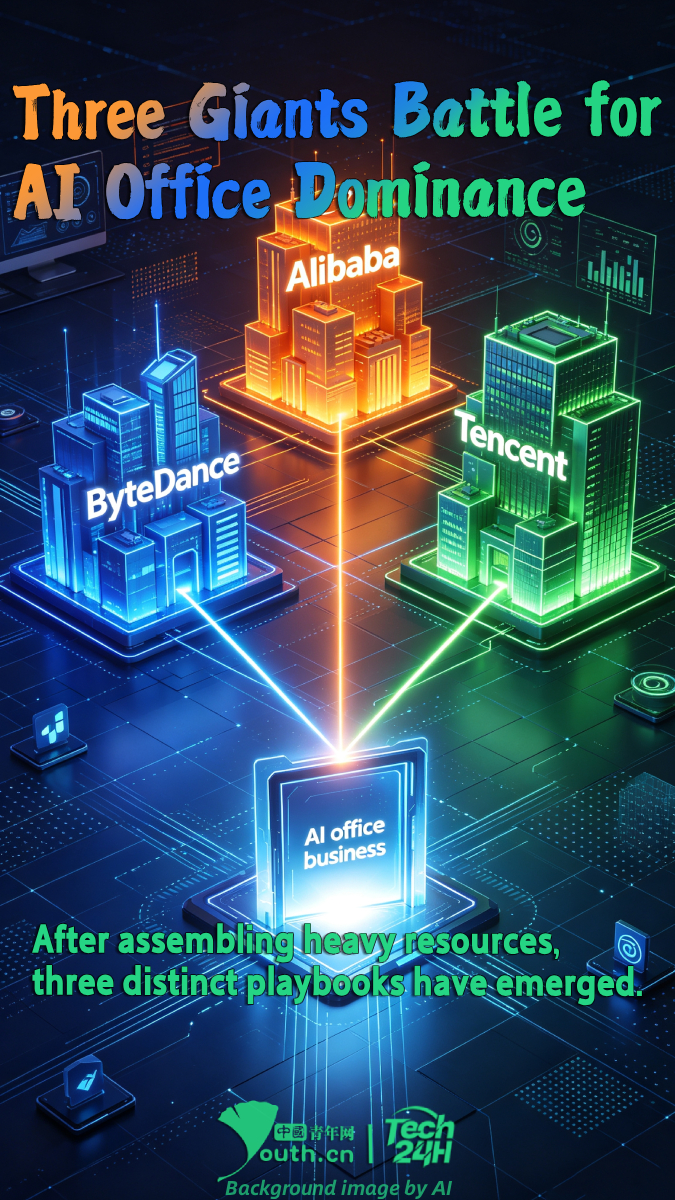
【#Tech24H】In 2026, large language models achieved a capability leap from "being able to chat" to "being able to work." Users only need to provide a goal, and the model can autonomously break down tasks and call tools across systems, moving from "helping you write" to an Agent-style "getting it done for you." On September 15, ByteDance announced that it had completed a systematic reorganization of its AI office business, integrating Doubao, Lark, and Volcengine into an integrated enterprise intelligence platform, and promised to scale up investment in the enterprise market. A battle for the workplace desktop entry point among China's three major tech giants—ByteDance, Tencent, and Alibaba — has thus fully begun. The giants are racing to seize the window of qualitative transformation for AI office productivity. After assembling heavy resources, three distinct playbooks have emerged. Tencent relies on WeCom, Alibaba relies on DingTalk and Taobao’s SME merchants, and ByteDance builds on its content creation ecosystem. According to iiMedia Research, ByteDance’s deep integration delivers a smooth user experience, but building connectors to integrate with external systems requires case-by-case negotiations. Alibaba has a deeper grasp of organizational context, yet maintaining cross-platform product consistency remains an ongoing challenge.