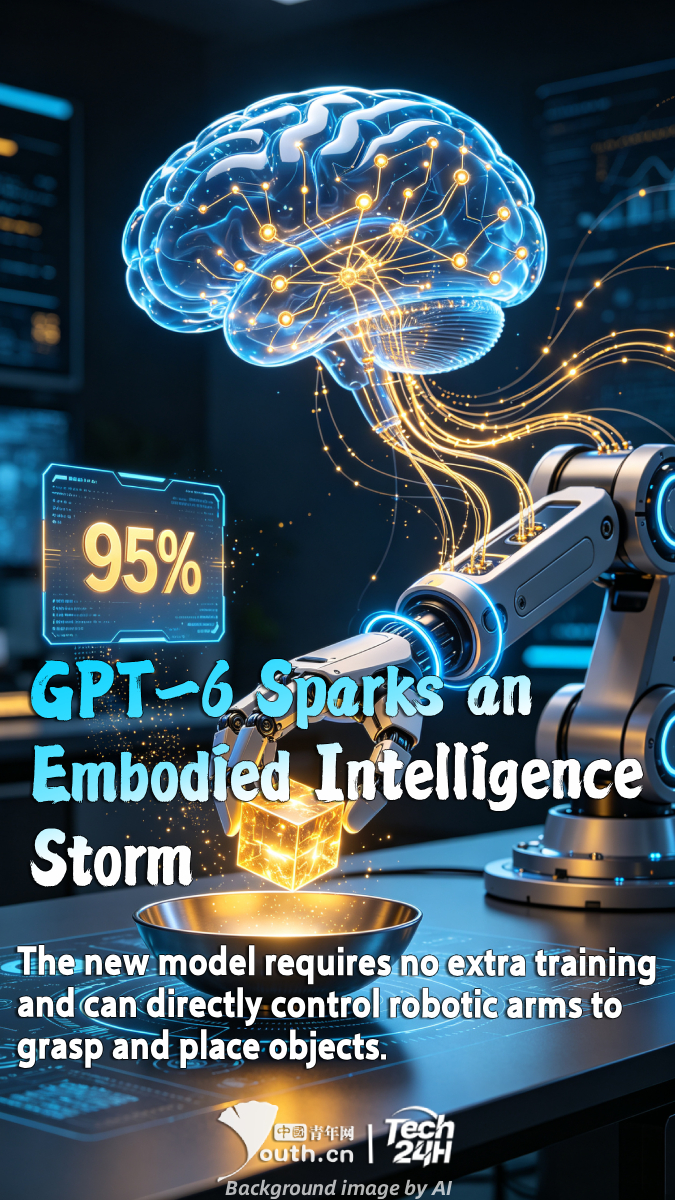
【#Tech24H】In early September, OpenAI released GPT-6 Astra, and in the days that followed, videos of robotic arms circulated across social networks. The new model requires no extra training and can directly control robotic arms to grasp and place objects. Physical tests conducted by independent evaluation agency Robocurve show that for the dual-arm robot task of "grasping a block and placing it into a bowl", Astra achieved a 95% success rate, far above the 40% of Claude Fable 5.1. At present, Astra has not yet delivered substantive changes to the embodied intelligence field, and relevant impacts remain mostly speculative. The truly noteworthy question is: if Astra cannot replace embodied models, what should the relationship be between Astra and embodied models? The answer is most likely a layered model, regarded as a technical path distinct from VLA and world models. The upper layer is a general large model, responsible for semantic understanding, task planning, and scheduling; the lower layer is a specialized embodied model, responsible for perception, control, and physical interaction. Overall, the most probable future will not be one side swallowing the other, but layered coexistence. Players such as OpenAI build the "brain", while embodied-tech companies develop the cerebellum and body, collaborating via standardized interfaces. Just like the human brain: the cerebrum handles thinking, the cerebellum manages movement, and the spinal cord takes charge of reflexes. Each part stays in its proper position, and all are indispensable.