
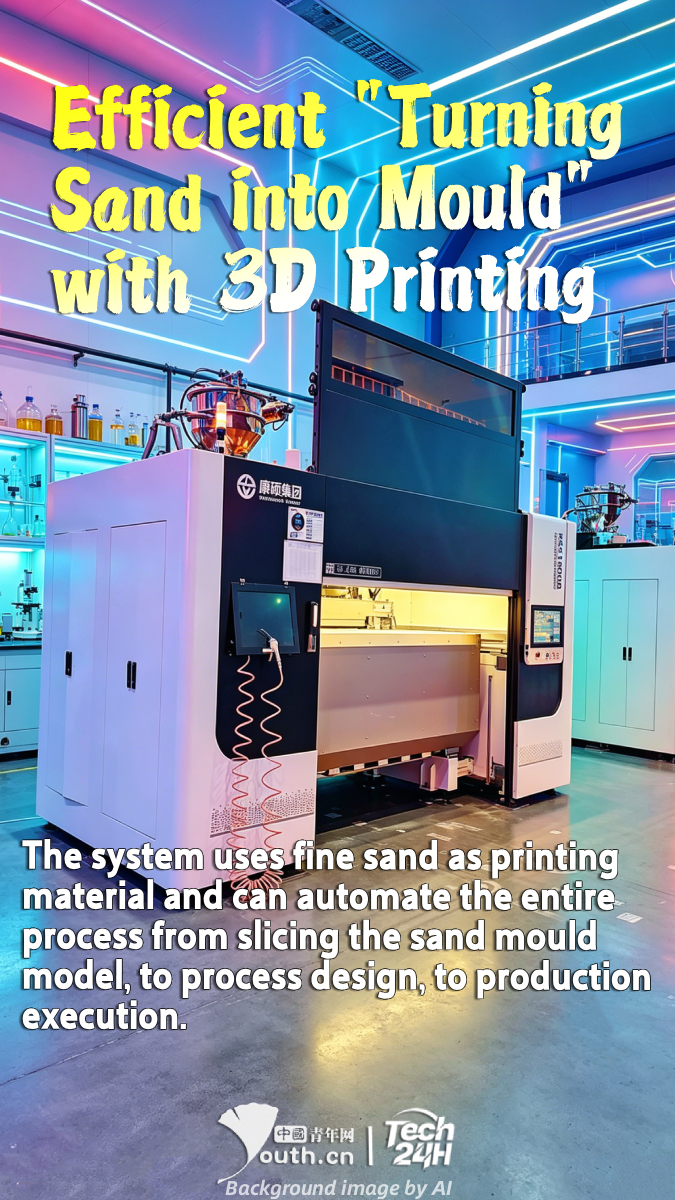
【#Tech24H】In traditional casting, producing a metal part requires a mould maker to create a mould according to blueprints before pouring, a process that takes weeks. Today, intelligent 3D printing is revolutionising this workflow, greatly improving mouldmaking efficiency. Recently, Kangshuo Electric Group Co., Ltd. put into operation its selfdeveloped intelligent unmanned 3D sand mould printing system. According to reports, the system uses fine sand as printing material and can automate the entire process from slicing the sand mould model, to process design, to production execution. Before printing, a technician uses proprietary software to capture and slice images, generating 2D images, and then imports them into the printing console, where the system software automatically generates key information such as sand mould parameters and material usage. On a worktable 1.8 metres long and 1 metre wide, a sand spreader moves at 400 mm per second to spread fine sand particles 150 microns in diameter coated with a hardening agent. As the print head carriage passes over, thousands of microscopic nozzles precisely jet a binder, which instantly reacts and bonds with the hardening agent on the sand particles. After printing, the sand mould undergoes cleaning, drying and other steps to complete production. Traditional sand mould manufacturing takes weeks, while this 3D printing process takes only one day, a dramatic increase in efficiency. [ By Zhang Liyan | Tang Ruohan ]