
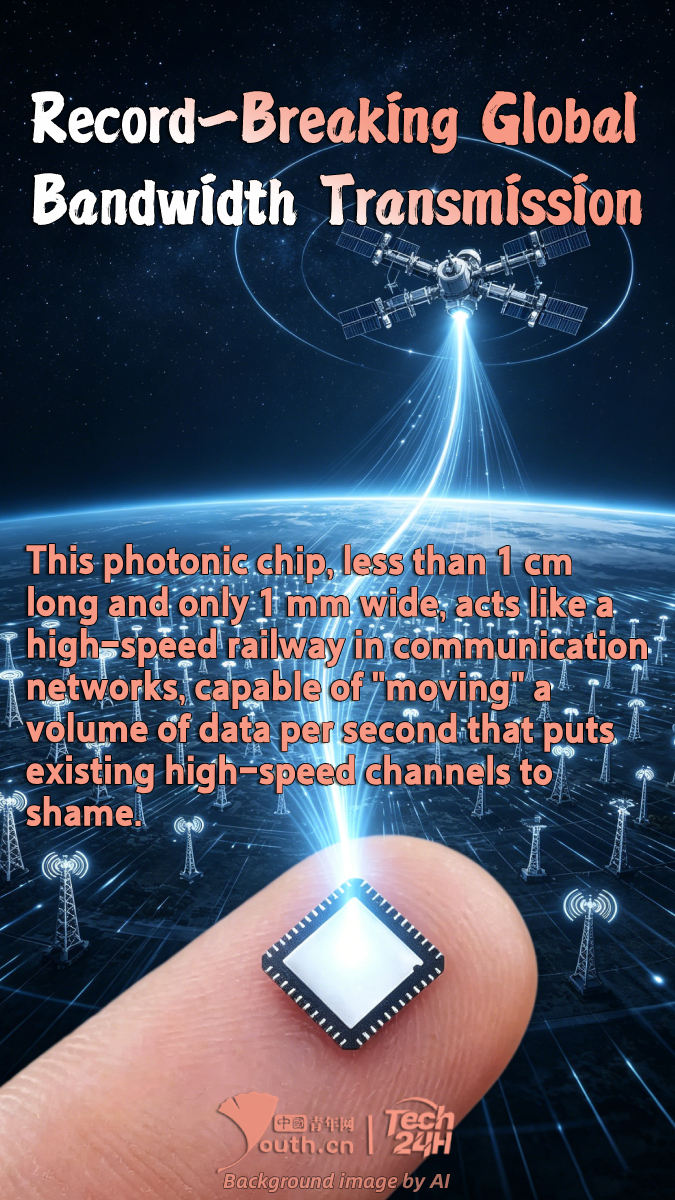
【#Tech24H】Smartphones and computers process electrical signals, but long-distance data transmission requires converting them into optical signals. As the hub for converting between electrical and optical signals, a photonic chip's bandwidth determines how much data can be transmitted per unit time. An ultra-wideband photonic chip independently developed by China's National Information Optoelectronics Innovation Center, in collaboration with Peking University, Pengcheng Laboratory, and other institutions, boasts a bandwidth of 250 GHz, setting a new global record for such devices. The research team focused on thin-film lithium niobate materials, which offer higher electro-optic conversion efficiency and lower driving voltage. After three years of iteration, they pushed the chip's transmission bandwidth from 110 GHz to 145 GHz, then to 170 GHz, and now to 250 GHz. This photonic chip, less than 1 cm long and only 1 mm wide, acts like a high-speed railway in communication networks, capable of "moving" a volume of data per second that puts existing high-speed channels to shame. In the lab, it has already achieved a fiber-optic rate of 512 Gbps and a terahertz wireless rate of 400 Gbps, enough for 86 users to simultaneously stream 8K video, providing the “heart” for signal transmission in future 6G communications and spaceborne communications. [ By Zhang Liyan | Tang Ruohan ]