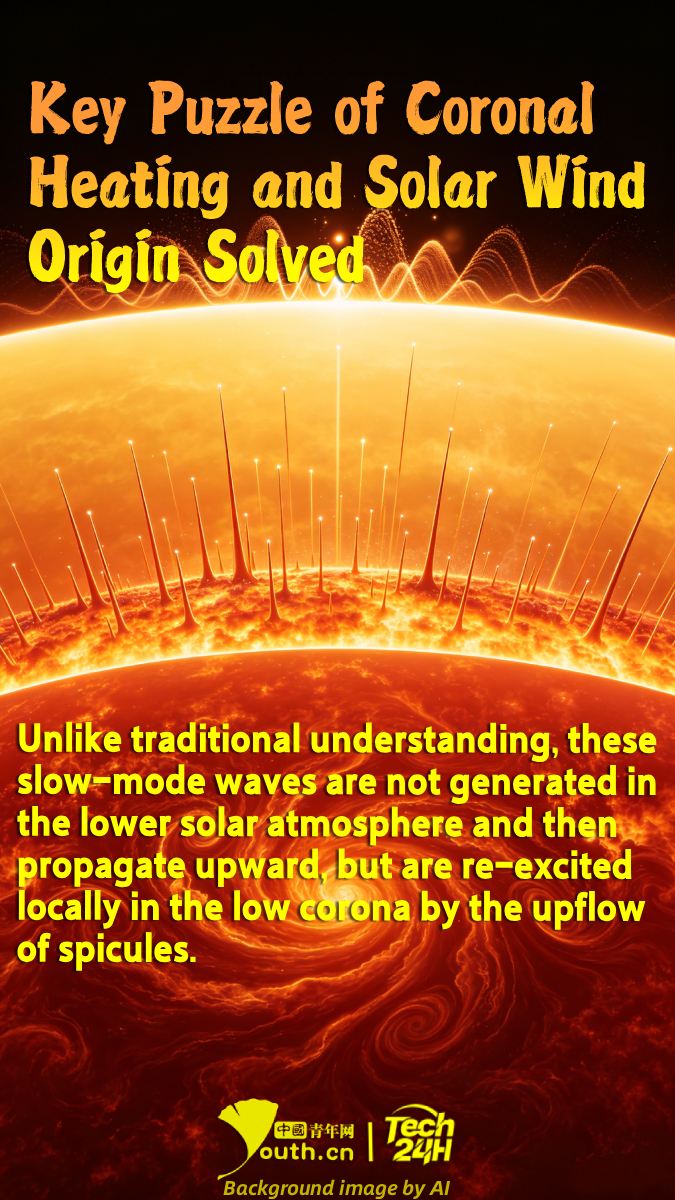
【#Tech24H】The Yunnan Observatories of the Chinese Academy of Sciences, in collaboration with research teams from India and the UK, has achieved significant progress in the study of coronal heating and solar wind origin in coronal hole regions, providing new evidence for understanding the heating mechanism of stellar atmospheres. Through simulation studies, the team has, for the first time, fully reproduced the entire physical process from the solar convection zone to the low corona, including the self-excitation of convective turbulence and the spontaneous generation of spicules. The simulation shows that convective and turbulent motions trigger small-scale magnetic reconnection and shock structures, which together drive the periodic generation of spicules. As spicules rise, the plasma flows they carry into the corona continuously excite slow-mode waves and shocks locally, and the associated energy flux is effectively dissipated through thermal conduction and compression, directly heating the low corona. Unlike traditional understanding, these slow-mode waves are not generated in the lower solar atmosphere and then propagate upward, but are re-excited locally in the low corona by the upflow of spicules.