
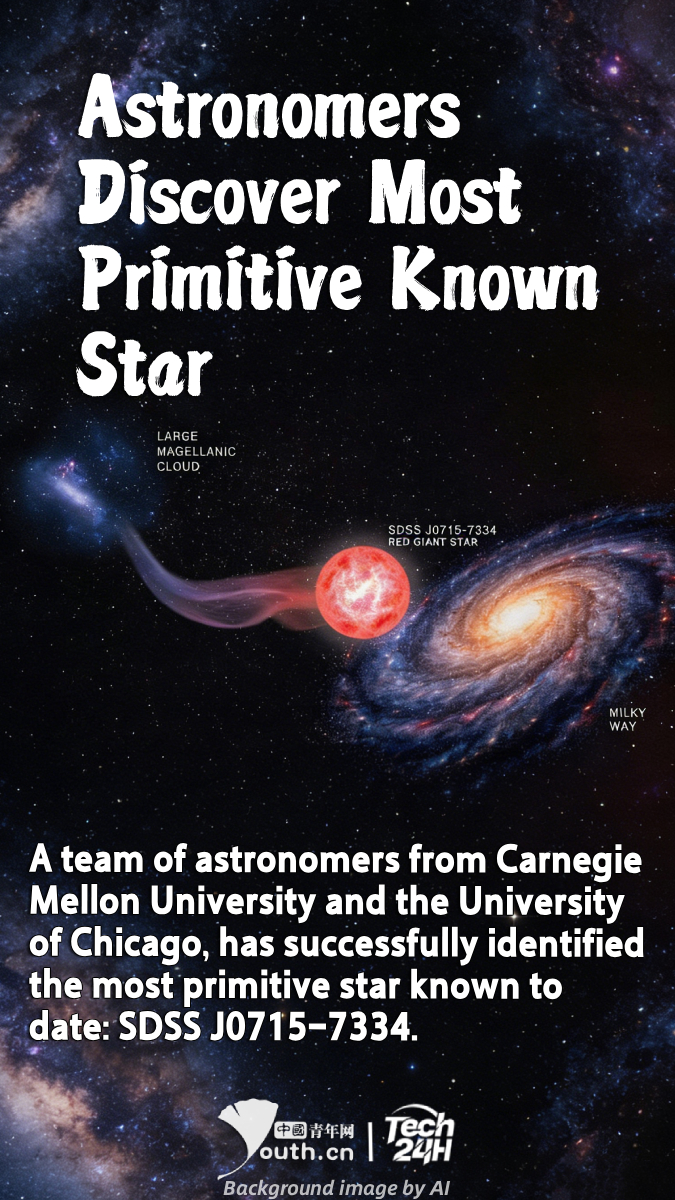
【#Tech24H】A team of astronomers from Carnegie Mellon University and the University of Chicago, combining data from the fifth phase of the Sloan Digital Sky Survey (SDSS) with observations from the Magellan Telescope in Chile, has successfully identified the most primitive star known to date: SDSS J0715-7334. In astronomy, all elements heavier than helium are collectively called “metals”. Stars with extremely low metal content are known as “primitive stars” or “metal-poor stars”. SDSS J0715-7334 belongs to the second generation of stars and is a red giant. Spectroscopic and chemical analysis from the Magellan Telescope shows that its metal content is less than 0.005% of that of the Sun, one-half that of the previous record holder and just one-fortieth of the most iron-poor star known, setting a new observational record. Using data from the European Space Agency’s Gaia probe, the team traced the star’s trajectory. It originally formed near the Large Magellanic Cloud and now “resides” in the Milky Way, about 80,000 light-years from Earth.