
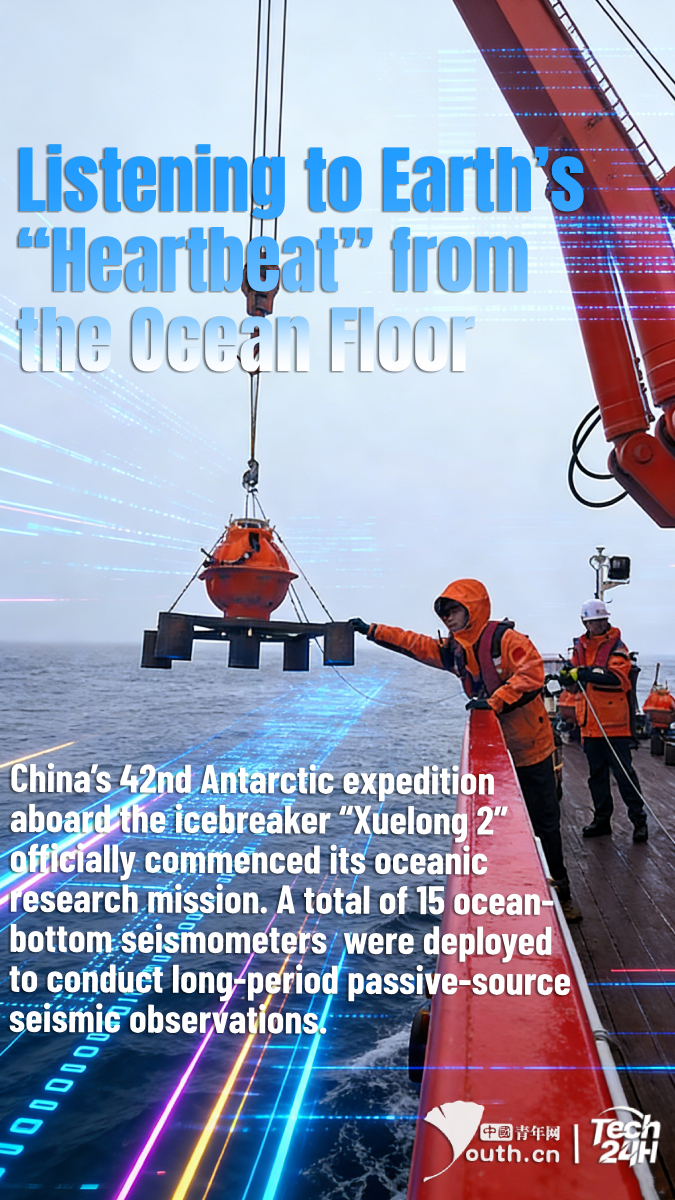
【#Tech24H】Recently, China’s 42nd Antarctic expedition aboard the icebreaker “Xuelong 2” officially commenced its oceanic research mission. A total of 15 ocean-bottom seismometers were deployed to conduct long-period passive-source seismic observations, aimed at capturing natural seismic signals from this region and adjacent areas. The Earth is in constant vibration, and seismic signals contain a wealth of information. Originating from the seismic source, seismic waves may traverse various media, such as rock, magma, and sediment, before reaching observation points. The propagation speed of seismic waves is a key characteristic of these media. Waves travel slower through soft or molten materials and faster through hard, dense substances. By analyzing seismic signals to obtain velocity information, scientists can create a “3D map” of Earth’s interior.