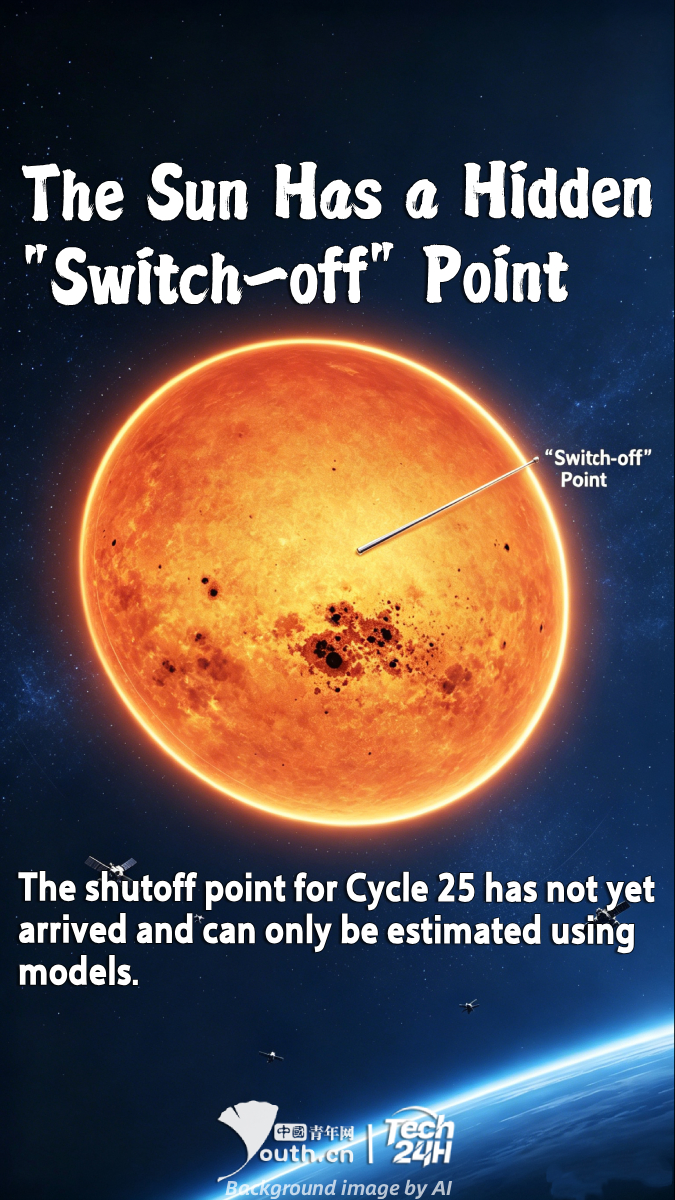
【#Tech24H】The Sun has its own “schedule”. It goes through activity cycles approximately every 11 years, oscillating between quiescent and active phases. During each cycle, the Sun's magnetic field reverses, and the number of sunspots on its surface rises from a minimum to a maximum and then declines again. More sunspots mean a greater likelihood of solar flares and coronal mass ejections, which can affect satellites, communications, navigation systems, and even power grids on Earth. A team of physicists from the University of Warwick has developed a “solar clock” model and discovered that the Sun does not gradually return to calm; instead, each cycle features a distinct phase in which the most intense space-weather activity abruptly ceases. The scientists term this juncture the “Switch-off” Point. Preliminary estimates suggest that the peak sunspot number for Solar Cycle 26 will be around 100 - 120, indicating a moderate-intensity cycle similar to the current Cycle 25, and possibly slightly weaker. The shutoff point for Cycle 25 has not yet arrived and can only be estimated using models. In about two years, when that moment actually occurs, observational data will allow for much more accurate recalculation. By then, there will still be seven years until the peak of Cycle 26, a considerable lead time. [ By Zhang Liyan | Tang Ruohan ]