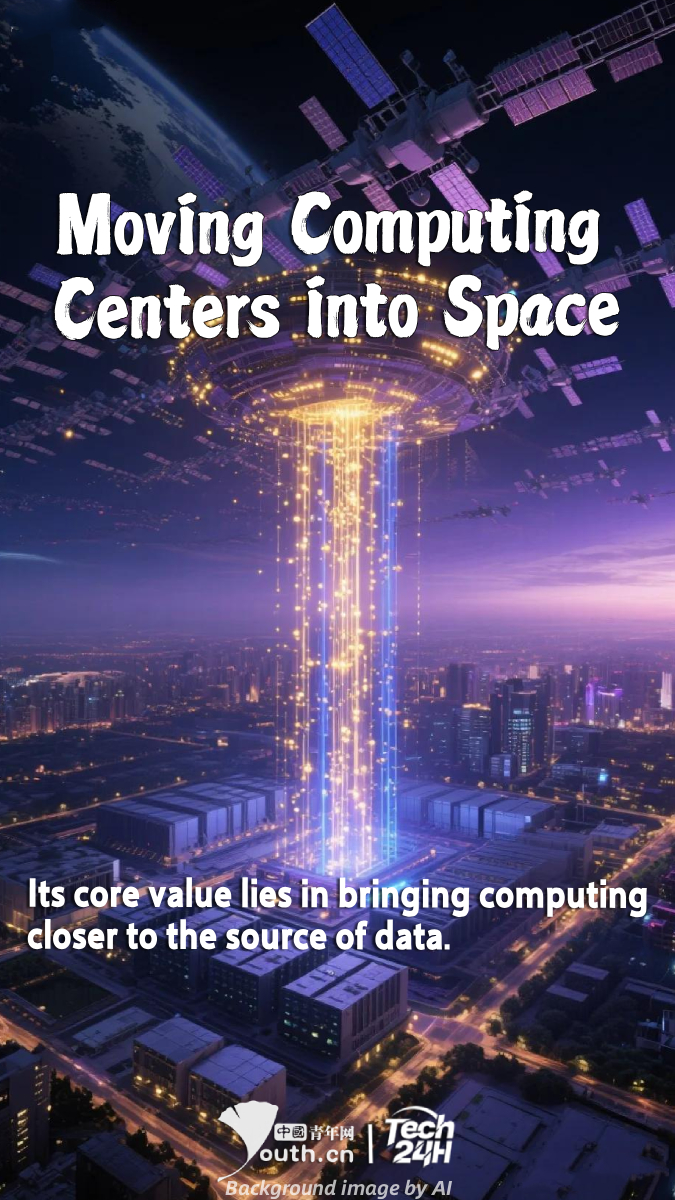
【#Tech24H】Recently, Beijing has established the Space Intelligent Computing Research Institute and the Space Computing Industry Innovation Center, Tianjin has formed a joint research consortium for space-based digital infrastructure, and Shanghai has launched the Space Computing Industry Ecosystem Partnership Program. A number of regions are accelerating forward-looking deployments in space-based computing. Why deploy computing capabilities in space? Space-based computing refers to placing computing, storage, and intelligent data processing capabilities in a space environment, leveraging satellites, low-Earth-orbit constellations, space stations, or dedicated space platforms to provide computational power. Its core value lies in bringing computing closer to the source of data. If intelligent processing, feature extraction, and preliminary decision-making can be completed on orbit, and only high-value information is transmitted back to Earth, the overall efficiency and timeliness of the system will be significantly improved. Space-based computing is not meant to replace terrestrial data centers but to complement them, specifically addressing special mission-critical scenarios such as wide-area monitoring, emergency dispatching, and cross-border global perception. It completes the full closed loop from data acquisition and on-orbit computation to command issuance, forming a comprehensive computing supply system in which general-purpose ground computing and specialized space computing complement each other, thus opening up new development horizons for new quality productive forces. [ By Zhang Liyan | Tang Ruohan ]