
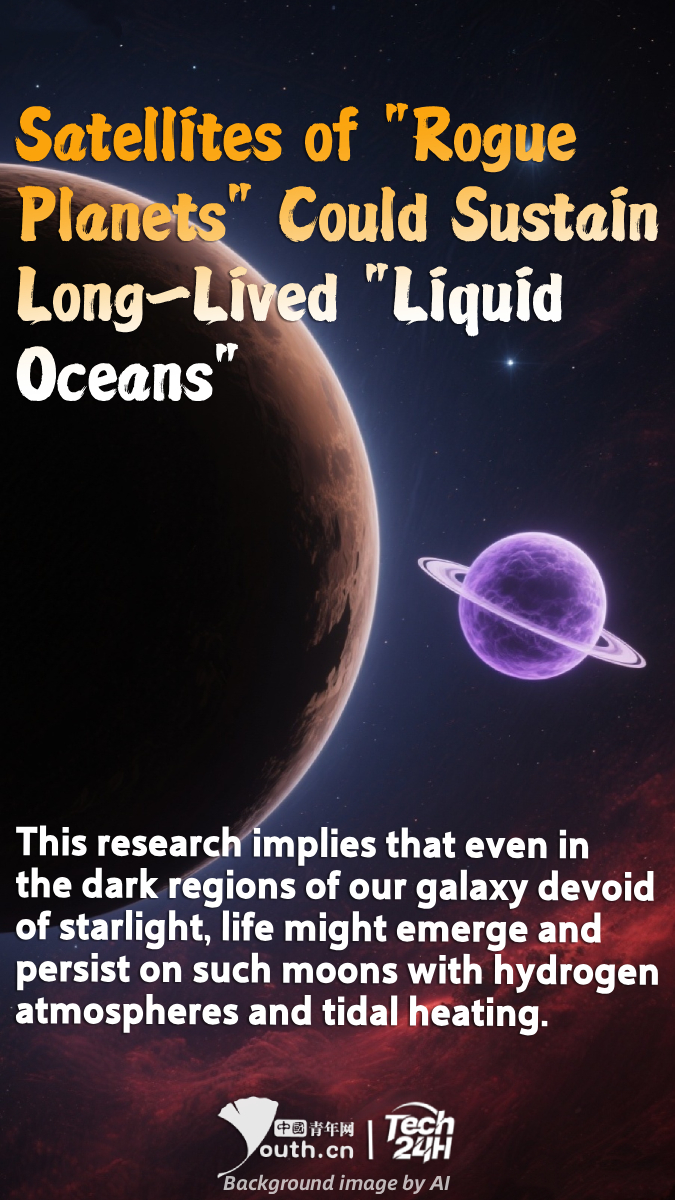
【#Tech24H】Research jointly conducted by the ORIGINS Excellence Cluster at LMU Munich and the Max Planck Institute for Extraterrestrial Physics suggests that moons orbiting free-floating “rogue planets” could maintain stable liquid oceans on their surfaces for up to 4.3 billion years if they possess a thick hydrogen-rich atmosphere. This timescale is nearly comparable to Earth’s age, potentially sufficient for complex life to evolve. Estimates indicate that the number of free-floating planets in the Milky Way may rival the number of stars. This research implies that even in the dark regions of our galaxy devoid of starlight, life might emerge and persist on such moons with hydrogen atmospheres and tidal heating. Searching for these habitable worlds could become a crucial new direction in the future detection of extraterrestrial life.