
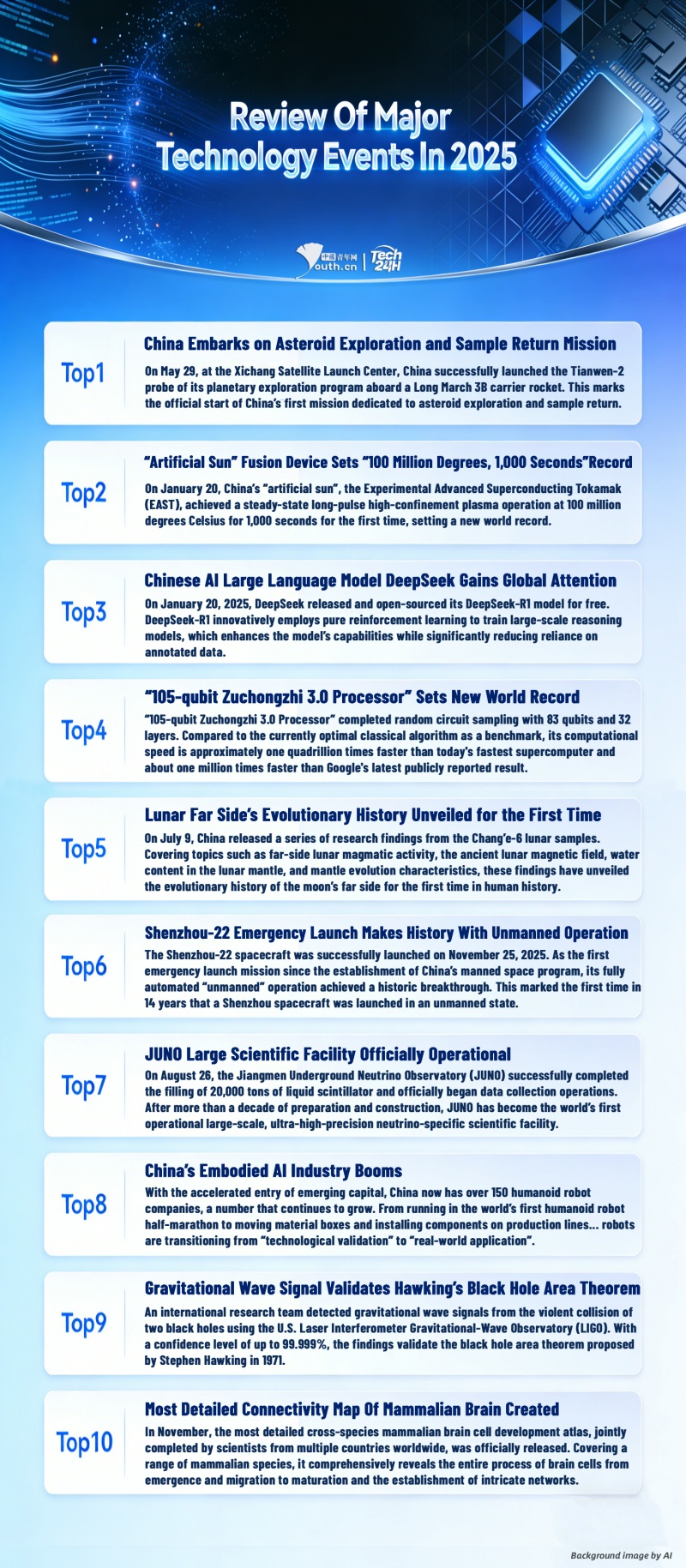
Top1: China Embarks on Asteroid Exploration and Sample Return Mission
On May 29, at the Xichang Satellite Launch Center, China successfully launched the Tianwen-2 probe of its planetary exploration program aboard a Long March 3B carrier rocket. This marks the official start of China’s first mission dedicated to asteroid exploration and sample return. The primary mission objectives of Tianwen-2 include the detection, sampling, and return of asteroid 2016HO3, with the expected landing and recovery on Earth by late 2027. Following this, the mission will proceed with scientific exploration of the main-belt comet 311P.
Top2: "Artificial Sun” Fusion Device Sets “100 Million Degrees, 1,000 Seconds”Record
Inside the sun, nuclear fusion reactions occur every moment, providing energy for all life on Earth. The goal of the “artificial sun” is to achieve controllable nuclear fusion on Earth, offering humanity the “ultimate solution” to energy challenges. On January 20, China’s “artificial sun”, the Experimental Advanced Superconducting Tokamak (EAST), achieved a steady-state long-pulse high-confinement plasma operation at 100 million degrees Celsius for 1,000 seconds for the first time, setting a new world record. This milestone marks China’s progress in fusion energy research from fundamental exploration to engineering practice, significantly advancing global efforts toward achieving controllable nuclear fusion.
Top3: Chinese AI Large Language Model DeepSeek Gains Global Attention
On January 20, 2025, DeepSeek released and open-sourced its DeepSeek-R1 model for free. DeepSeek-R1 innovatively employs pure reinforcement learning to train large-scale reasoning models, which enhances the model’s capabilities while significantly reducing reliance on annotated data. Even more encouragingly, DeepSeek upholds the philosophy of openness by publicly sharing the model architecture, training tools, and data processing workflow, inviting developers worldwide to collaboratively participate in ecosystem building.
Top4: “105-qubit Zuchongzhi 3.0 Processor” Quantum Computing Prototype Sets New World Record
Quantum computing possesses formidable capabilities that surpass classical computing in specific tasks and is regarded as a key technology for the next-generation information revolution. The superconducting quantum computing prototype “105-qubit Zuchongzhi 3.0 Processor” jointly developed by the University of Science and Technology of China in collaboration with multiple domestic research institutions, has broken the world record for quantum computational advantage in superconducting systems. According to tests, “105-qubit Zuchongzhi 3.0 Processor” completed random circuit sampling with 83 qubits and 32 layers. Compared to the currently optimal classical algorithm as a benchmark, its computational speed is approximately one quadrillion times faster than today's fastest supercomputer and about one million times faster than Google's latest publicly reported result. This demonstrates the strongest quantum computational advantage currently achieved in this field.
Top5: Lunar Far Side’s Evolutionary History Unveiled for the First Time
On July 9, the Chinese Academy of Sciences released a series of research findings from the Chang’e-6 lunar samples. Covering topics such as far-side lunar magmatic activity, the ancient lunar magnetic field, water content in the lunar mantle, and mantle evolution characteristics, these findings have unveiled the evolutionary history of the moon’s far side for the first time in human history. The most prominent geological feature on the far side of the moon is the South Pole-Aitken Basin. Due to the lack of samples, understanding of the South Pole-Aitken Basin has been extremely limited, with research relying only on scarce data such as topography. The Chang’e-6 mission’s landing in the South Pole-Aitken Basin on the far side of the moon has filled this gap in the study of lunar far-side evolution.
Top6:Shenzhou-22 Spaceship Emergency Launch Makes History With Unmanned Operation
The Shenzhou-22 spacecraft was successfully launched on November 25, 2025. As the first emergency launch mission since the establishment of China’s manned space program, its fully automated “unmanned” operation achieved a historic breakthrough. This marked the first time in 14 years that a Shenzhou spacecraft was launched in an unmanned state, and the mission emblem notably omitted the word “manned” for the first time. The unmanned design not only reduced mission risks but also eliminated the complex procedures required for in-orbit crew handovers. This significantly enhanced emergency response efficiency and provided a new operational model for future space emergency rescue missions.??
Top7: JUNO Large Scientific Facility Officially Operational
On August 26, the Jiangmen Underground Neutrino Observatory (JUNO) successfully completed the filling of 20,000 tons of liquid scintillator and officially began data collection operations. After more than a decade of preparation and construction, JUNO has become the world’s first operational large-scale, ultra-high-precision neutrino-specific scientific facility. It will be capable of addressing fundamental questions about the nature of matter and the universe. Designed for a 30-year operational lifespan, JUNO can later be upgraded for neutrinoless double-beta decay experiments to measure the absolute mass of neutrinos and determine whether neutrinos are Majorana particles. This will help resolve cutting-edge interdisciplinary challenges in particle physics, astrophysics, and cosmology, profoundly advancing humanity’s understanding of the universe.
Top8: China’s Embodied AI Industry Booms
With the accelerated entry of emerging capital, China now has over 150 humanoid robot companies, a number that continues to grow. From running in the world’s first humanoid robot half-marathon to moving material boxes and installing components on production lines, sorting medications and assisting in surgeries in hospitals, brewing coffee and folding clothes in homes, “delivering lectures” in classrooms, and dancing alongside human performers on stage... robots are transitioning from “technological validation” to “real-world application”.
Top9: Gravitational Wave Signal Validates Hawking’s Black Hole Area Theorem
An international research team detected gravitational wave signals from the violent collision of two black holes using the U.S. Laser Interferometer Gravitational-Wave Observatory (LIGO). With a confidence level of up to 99.999%, the findings validate the black hole area theorem proposed by Stephen Hawking in 1971. This achievement provides a crucial foundation for research on quantum gravity theory.
Top10: Most Detailed Connectivity Map Of Mammalian Brain Created
In the quest to explore the most complex organ of life, the brain, the scientific community has taken a milestone step. In November, the most detailed cross-species mammalian brain cell development atlas, jointly completed by scientists from multiple countries worldwide, was officially released. Covering a range of mammalian species from mice to humans, it comprehensively reveals the entire process of brain cells from emergence and migration to maturation and the establishment of intricate networks. This marks the formal entry of brain science research into a new phase of systematization and dynamism.